The framework
The Science of Social Justice.
An interdisciplinary theoretical framework grounded in neuroscience, anthropology, and education — built on the proposition that social justice and well-being are the same thing.
What this paper is about
I wrote this paper in the thick of it — the pandemic was unraveling whatever fictions we still held about whose well-being mattered, George Floyd had been murdered, Portland was on fire, and the whole country was being asked to feel — really feel — what centuries of unmediated violence had done to the collective nervous system. And I wanted to make an argument that science, of all things, could meet us there.
The Science of Social Justice begins from a simple, almost stubborn proposition: social justice and well-being are the same thing. Not adjacent. Not related. The same thing. When I say "social" I don't mean policy or politics first — I mean the embodied experience of our shared interbeing, the relational sphere where we actually live. And when I say "justice" I don't mean punishment or even fairness in the legal sense — I mean loving-awareness-in-action. Justice as something you can feel in your body when you turn toward another person, or toward yourself, with the intention to heal rather than to harm.
The paper braids together neuroscience, anthropology, contemplative practice, and interpersonal neurobiology to show that intergenerational trauma — the inheritance carried in our cortisol, our DNA methylation, our nervous systems, our family stories — is not a problem we can solve through policy alone, or through individual meditation alone. It lives in the body, and it has to be met in the body. And it has to be met together.
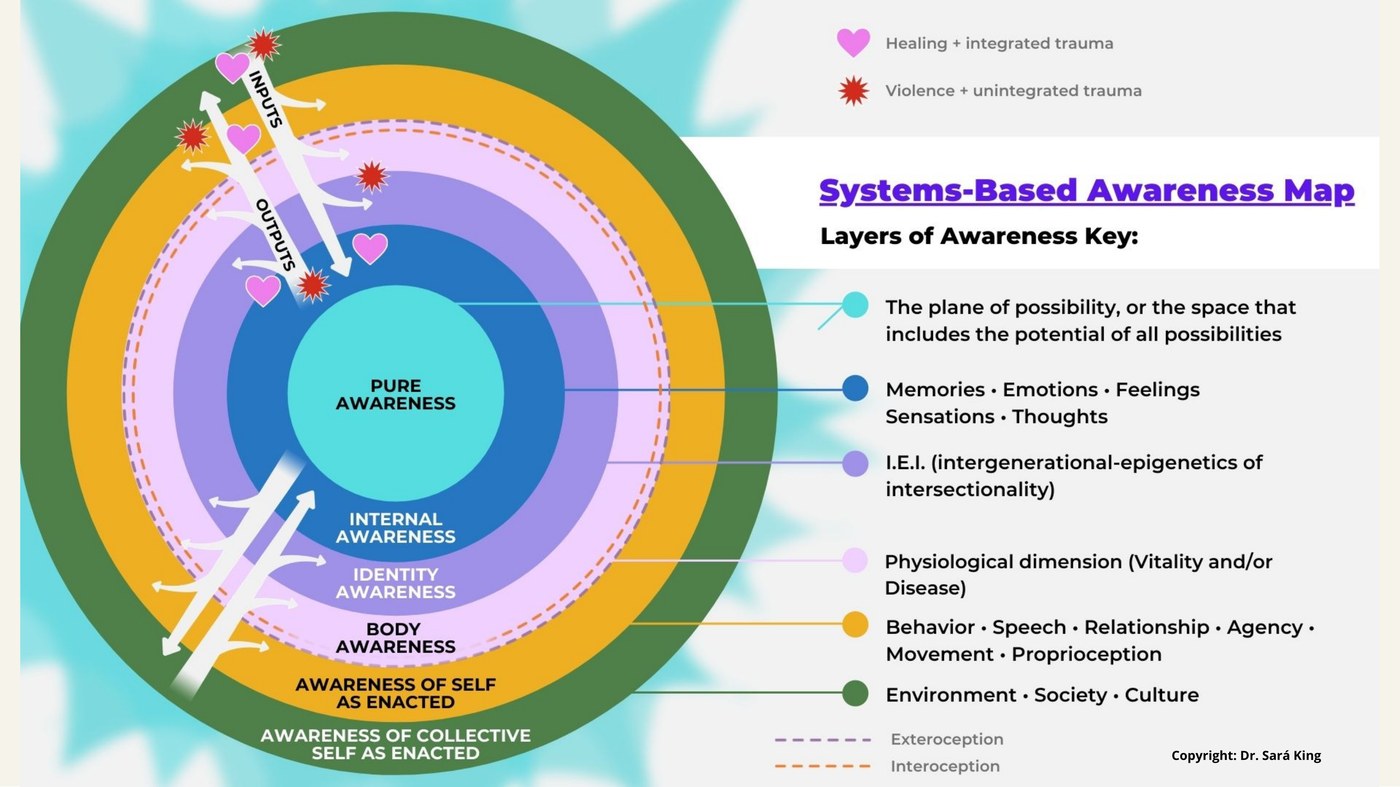
I also introduce the Systems-Based Awareness Model (SBAM) — a visual map of how awareness moves through us in layers: from pure awareness, through internal awareness, identity, body, the self-as-enacted, all the way out to the collective-self-as-enacted. A way of seeing how an interior breath ripples into a shared world.
What's at stake here is whether we will keep handing the responsibility for healing to the most vulnerable, or whether we will finally let science say what Black women, Indigenous elders, contemplatives, and the disabled have been saying forever: if you have a body, you deserve well-being. None of us are free until all of us are.
The map
The Systems-Based Awareness Model.
A visual model of how human awareness moves through nested layers — and how trauma contracts these layers while healing expands them.
The language
The framework's vocabulary.
These are the named concepts the paper introduces and relies on. The language is part of the contribution.
SSJ
The Science of Social Justice
An interdisciplinary theoretical framework, grounded in neuroscience, anthropology, and educational theory, built on the proposition that social justice and well-being are the same thing — and that healing intergenerational trauma is therefore a scientific, embodied, and collective practice.
Loving-awareness
The energy of attention and intention applied to our internal reality so it can shape our external reality with care; an embodied capacity to direct awareness toward healing rather than harm.
Loving-awareness-in-action
Sará's redefinition of justice. Actions and relationships that embody compassion, loving-kindness, gratitude, altruism, empathy, and prosociality as the felt expression of social justice.
SBAM
Systems-Based Awareness Model
A theoretical map and visual model of how human awareness moves through nested layers — pure awareness, internal awareness, identity awareness, body awareness, awareness-of-self-as-enacted, and awareness-of-collective-self-as-enacted — and how trauma contracts these layers while healing expands them.
The collective nervous system
Two or more humans whose relationality lets them share an intention to heal from internalized oppression and emanate well-being through the collective consciousness; an emergent shared physiology of belonging.
IEI
Intergenerational Epigenetics of Intersectionality
Sará's term for the truth that identity is always shaped by the ancestors who came before us, the environments they lived in, the genes they passed forward, and the intersecting facets — race, gender, class, ability — that color how we are seen and treated.
Aggression-masquerading-as-compassion
The shadow side of awareness practice: when contemplative teachings ignore identity and end up policing or controlling internal experience under the guise of care, often re-inscribing the harms of dominant culture.
Embodied social justice
Justice as a somatic, felt experience — what social justice feels like in the body when practiced individually and collectively, rather than only as policy or law.
Interbeing
How Sará redefines social: not a category of policy, but the lived, embodied web of relationship in which we always already exist — the relational sphere of our shared interbeing.
Lovingly-disrupt
A stance toward institutionalized racism, discrimination, and othering: interrupting cycles of unmediated pain with the tools and safe spaces required for healing.
From the paper
The central proposition of the Science of Social Justice is that social justice and well-being are one and the same thing.— Dr. Sará King, The Science of Social Justice
If you have a body, then you deserve well-being.— Dr. Sará King
Regardless of whether we have benefited from systemic oppression or not, none of us can truly experience well-being until all of us do.— Dr. Sará King
We cannot heal from that which has been concealed from our own awareness.— Dr. Sará King
Justice lives nowhere else other than the body.— Rev. angel Kyodo Williams, quoted in The Science of Social Justice
Read the full paper
The peer-reviewed article.
The full theoretical paper, published in 2022 — approximately 32 pages, 9,000 words, with the complete SBAM exposition, the bibliography, and the citations that ground every claim. The summary above is a doorway; the paper itself is the room.
Download the PDF655 KB · PDF · Authored by Dr. Sará King
A theoretical framework
The Science of Social Justice: An Interdisciplinary Theoretical Framework Grounded in Neuroscience, Education, and Anthropology Towards Healing Intergenerational Trauma
Further reading
The SSJ Reader.
A curated collection of science, medicine, and contemplative work that models or mirrors what the Science of Social Justice argues. Updated as the field grows.
-
01→
My Grandmother's Hands: Racialized Trauma and the Pathway to Mending Our Hearts and Bodies
The Black somatic abolitionist text. Menakem makes the body the site where racialized trauma is held — and the site where it must be metabolized. One of the closest siblings to the Science of Social Justice.
-
02→
Radical Dharma: Talking Race, Love, and Liberation
Three Black dharma teachers naming what most American Buddhism has refused to: that liberation without justice is spiritual bypass. Williams' line "justice lives nowhere else other than the body" lives at the heart of the SSJ.
-
03→
Intergenerational transmission of trauma: epigenetic mechanisms
The foundational epigenetics-of-trauma paper. Yehuda's work with Holocaust survivors and their children is the scientific evidence that intergenerational trauma is not metaphor — it is methylation. This paper anchors the IEI in the SSJ.
-
04→
The Inner Work of Racial Justice: Healing Ourselves and Transforming Our Communities Through Mindfulness
Magee, a law professor and mindfulness teacher, offers contemplative practices for racial justice work that take identity seriously. Her work is exactly what the paper points to when it warns against aggression-masquerading-as-compassion.
-
05→
The Developing Mind: How Relationships and the Brain Interact to Shape Who We Are
Siegel's interpersonal neurobiology framework is one of the scientific spines of the SSJ. The premise that mind is relational — that we are always co-regulating one another's nervous systems — sits underneath everything in the paper.
-
06→
Emotions, Learning, and the Brain: Exploring the Educational Implications of Affective Neuroscience
Immordino-Yang shows that emotion is not separate from thinking — it is the substrate that makes thinking possible. The SSJ borrows her argument that education without emotional integration is harm.
-
07→
On Intersectionality: Essential Writings
Crenshaw's intersectional framework is the structural lens through which the IEI — the intergenerational-epigenetics of intersectionality — sees identity. There is no SSJ without intersectionality.
-
08→
Pleasure Activism: The Politics of Feeling Good
If loving-awareness-in-action has a sister text, this is it. brown's central claim — that movements which disregard pleasure cannot sustain themselves — runs adjacent to the SSJ proposition that well-being and justice are one and the same.
-
09→
Post Traumatic Slave Syndrome: America's Legacy of Enduring Injury and Healing
DeGruy's framework for the unresolved transgenerational injury of American chattel slavery names at the level of culture what the SSJ paper engages with at the level of biology. A foundational text on healing the inheritance.
-
10→
The Body Keeps the Score: Brain, Mind, and Body in the Healing of Trauma
The popular synthesis of what trauma does and where it lives. Imperfect, contested in places, but the doorway most general readers walk through. A starting point for the longer conversation the SSJ is part of.
A sibling project
These pieces also live in the zine.
Each reader entry gets a fuller treatment in a recurring zine column — Field Notes from the Science of Social Justice — where I write at length about a single piece, the field it belongs to, and what it asks of us. The SSJ Reader catalogs the work; the zine sits with it.
Visit the zine →Engage further
If the framework speaks to you.
The Science of Social Justice lives in three places beyond the page — in the rooms I hold one-to-one with leaders, in the engagements I bring to organizations and teams, and in the book that is currently being written. Each one is a different way of putting this work into your body and your context.